
This shift introduces two core issues: the reduction of system inertia, which weakens the grid's ability to withstand disturbances, and a fundamental change in fault current characteristics.When a fault occurs, it can complete detection, analysis, and isolation within milliseconds, precisely confining the outage to a single block while the rest of the city remains brightly lit.
The global transformation towards smart grids is redefining the standards for power supply reliability. From mountainous areas covered with wind turbine blades to dense urban centers, a technology known as protective relaying is undergoing its most profound revolution in over a century.
According to authoritative market analysis, the global protective relay market is expected to expand at a compound annual growth rate (CAGR) of 6.1% between 2025 and 2031.
Fundamental changes in power systems pose unprecedented challenges to traditional protective relaying principles. The extensive integration of renewable energy sources, such as wind and solar, is transforming the conventional grid, which has been mostly reliant on synchronous generators, into a system governed by "Inverter-Based Resources" (IBRs).
This transition presents two primary concerns: the diminishment of system inertia, which compromises the grid's capacity to endure shocks, and a fundamental alteration in fault current characteristics. To protect their semiconductor switches, inverters typically limit short-circuit current output to 1.1-1.5 times the rated current. Their dynamic features also fluctuate according on the manufacturer's control technique, resulting in the loss of the predictable response pattern typical of synchronous machines.
This directly leads to frequent failures of traditional relay algorithms designed based on established synchronous machine fault characteristics. Simultaneously, the widespread deployment of Flexible AC Transmission System (FACTS) devices like Unified Power Flow Controllers (UPFCs) and series compensation equipment to enhance grid flexibility and transmission capacity severely interferes with the normal operation of traditional schemes such as distance protection and current differential protection due to their nonlinear dynamics.
Protective relay technology has undergone several paradigm changes in the past. The induction disk-type inverse-time overcurrent relay was first used in 1909. Digital protective relaying emerged in the 1980s, over a century later, thanks to the use of microprocessors, which combined several tasks into a single chip and drastically reduced space and wiring.
Entering the 21st century, the widespread adoption and integration of the IEC 61850 communication standard achieved the integration of protection, control, and monitoring, gradually forming the "digital nervous system" of substations.
The advantages of digital relays are comprehensive. They possess powerful self-diagnostic capabilities, enabling instant fault reporting; they operate faster, significantly shortening fault clearance time; and they provide detailed fault record waveforms, offering valuable data for subsequent analysis and prevention.
Confronted with complex challenges, cutting-edge research in protection technology focuses on the intelligence of algorithms. Adaptive protection is a mainstream direction, with its core being the ability of relay settings to automatically adjust with changing grid operating conditions, matching the constantly evolving topology and power flow.
More forward-looking exploration involves the deep integration of Artificial Intelligence (AI). A 2025 IEEE publication presented a novel method: for transmission lines connecting wind farms with UPFCs, researchers proposed an intelligent protection scheme based on Fast Discrete S-Transform and Gradient Boosting Ensemble Learning.
This scheme, requiring only three-phase current information from the grid side, achieved exceptional performance in MATLAB/Simulink simulations: 100% accuracy in fault detection and 99.86% accuracy in fault classification, with relatively low computational burden.
The variety of contemporary grid protection systems is increasing, meaning engineers must choose and incorporate them according to certain circumstances. The table below outlines the core characteristics of different protection strategies:
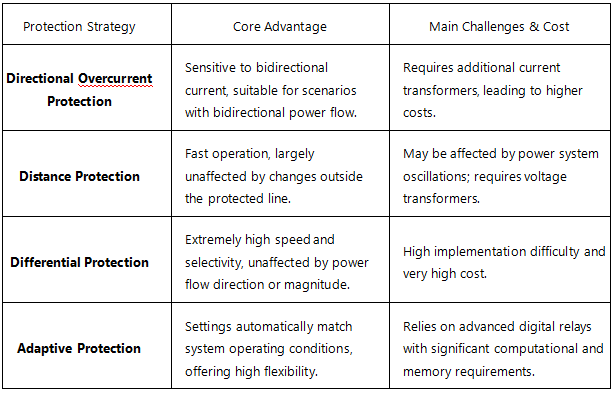
Today, a new generation of products is dedicated to integrating these functions. For example, relay modules that integrate sensor networks, high-speed communication, and intelligent algorithms can accurately distinguish between transient disturbances and real faults by analyzing magnitude, rate of change, and duration, executing millisecond-level "regionalized isolation" strategies.
Powerful technological drivers are translating into substantial market momentum. Globally, investment in grid modernization is the primary engine.
North America is investing heavily in upgrading its ageing grid, with over 70% of its high-voltage lines being more than 25 years old. Utilities are replacing electromechanical relays en masse with digital devices that support synchrophasors and adaptive protection.
In Europe, to achieve the "Fit-for-55" decarbonization goals, digital substations are being rapidly promoted, with the fiber-optic communication standard IEC 61850 becoming a mandatory requirement.
China leads demand with its massive Ultra-High Voltage (UHV) transmission projects. Its transmission lines require distance protection relays to operate within 1.5 cycles, setting a global technological benchmark.
In 2024, the Asia-Pacific region had the largest market share globally, while the generator protection segment is projected to grow at the highest CAGR.
The next frontier for protective relay technology will become more deeply integrated into the digital lifeblood of power systems. Its development clearly points towards several dimensions:
Deep Data Interconnection. Platforms for automatic fault data retrieval and centralized management are being built. In the future, engineers will be able to receive fault waveforms and analysis reports directly on their mobile phones, enabling them to make maintenance decisions instantly and transparently.
Expansion of application scenarios. As new elements such as electric vehicle charging stations, data centres and microgrids continue to grow rapidly, protective relays will need to ensure safety in a wider range of increasingly demanding environments.
Global Standard Convergence and Enhanced Security. Establishing international standards for IBRs and strengthening the hardware-level cybersecurity of relays in compliance with regulations like the EU's NIS-2 Directive will become industry norms.