 EN
EN
 English
 Español
 русский
 简体中文
简体中文

News
Content
- 1 What Is a Relay and How Does It Work?
- 2 The Main Purpose of a Relay: Core Functions Explained
- 3 Power Relays: Switching Heavy Loads with Precision
- 4 PCB Relay: Compact Control at the Board Level
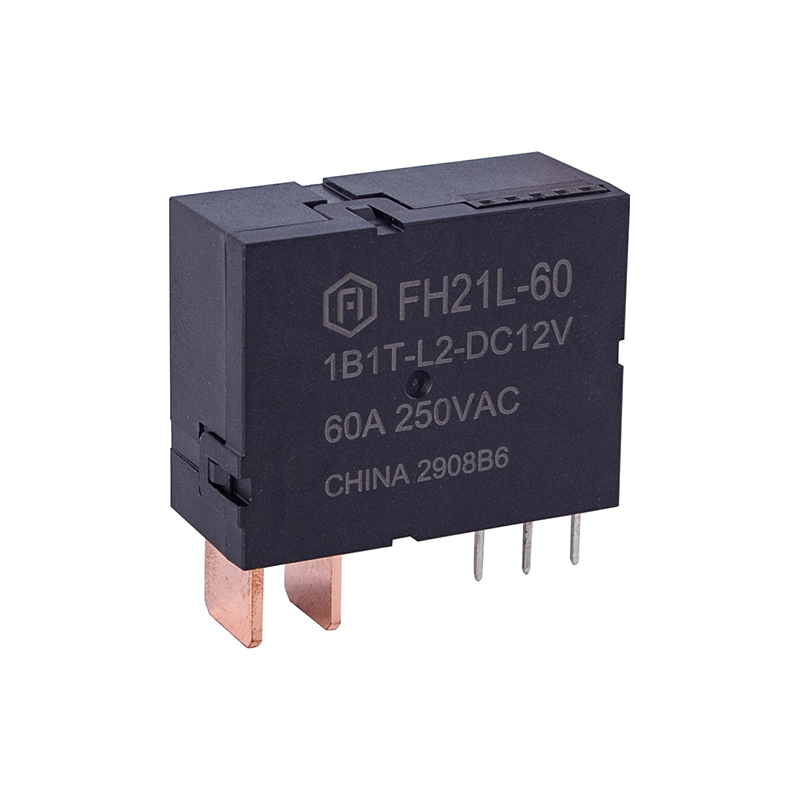
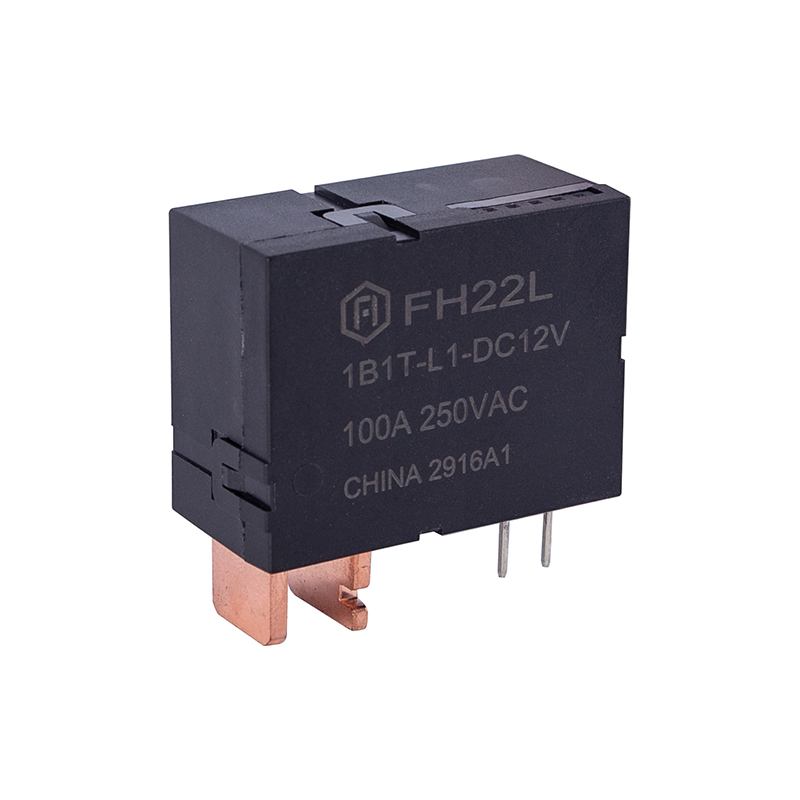
- 5 High-Current Relay: When Ordinary Switching Is Not Enough
- 6 Phase Protection Relay: Safeguarding Three-Phase Equipment
- 7 Voltage Monitor Relay: Continuous Vigilance Over Your Power Supply
- 8 Relay Types Compared: Choosing the Right Relay for Your Application
- 9 Key Parameters to Evaluate When Selecting a Relay
- 10 Relay Applications Across Industries
What Is a Relay and How Does It Work?
A relay is an electrically operated switch that uses a small input signal to control a much larger output circuit. At its core, a relay consists of an electromagnetic coil, an armature, and one or more sets of contacts. When current flows through the coil, it generates a magnetic field that attracts the armature, which physically opens or closes the contacts connected to the load circuit.
This simple but powerful mechanism allows engineers to control high-voltage or high-current circuits using low-power signals — a fundamental requirement in modern electrical and electronic systems. Whether installed on a circuit board or inside an industrial control panel, relays serve as the bridge between control logic and real-world electrical loads.
The operating principle can be summarized in three steps:
- A control signal (typically low voltage, e.g., 5V DC or 12V DC) energizes the relay coil.
- The electromagnetic field pulls the armature, changing the state of the relay contacts (NO to NC, or vice versa).
- The load circuit — which may carry 230V AC or hundreds of amps — is switched on or off accordingly.
This isolation between the control circuit and the load circuit is one of the relay's most critical features, providing both electrical isolation and safety for sensitive control electronics.
The Main Purpose of a Relay: Core Functions Explained
Understanding what relays are designed to do goes beyond just "switching." Relays fulfill several distinct and highly practical purposes in electrical engineering:
1. Circuit Isolation and Signal Amplification
One of the primary purposes of any relay is to allow a low-power control signal to switch a high-power load without direct electrical connection. A microcontroller output, for example, may only source 5–20 mA of current. A relay allows this tiny signal to switch loads drawing 10A, 30A, or even higher currents. This is the fundamental concept of signal amplification through isolation.
2. Remote Switching and Automation
Relays allow circuits located far apart to be controlled from a central point. In building automation, for instance, a relay installed near an HVAC unit can be activated by a thermostat signal from across the building. This remote switching capability is essential in industrial control systems, smart buildings, and process automation facilities.
3. Protection of Electrical Equipment
Protection relays — including phase protection relays and voltage monitor relays — are specifically designed to detect abnormal electrical conditions and disconnect the affected equipment before damage occurs. Common fault conditions that relays protect against include:
- Overvoltage and undervoltage
- Phase loss or phase reversal in three-phase systems
- Overcurrent and short-circuit conditions
- Ground faults and insulation breakdown
4. Logic Control and Interlocking
Before programmable logic controllers (PLCs) became widespread, relay logic was the backbone of industrial automation. Multiple relays wired together can implement AND, OR, and NOT logic functions. Even today, relay interlocks are used to prevent hazardous sequences — for example, ensuring a motor cannot be started in both forward and reverse directions simultaneously.
5. Time Delay Functions
Timer relays introduce a controlled delay between a trigger signal and a switching action. This is used in motor soft-start applications, sequential machine startup, and alarm delay circuits. Delay times can range from fractions of a second to several minutes depending on the application.
Power Relays: Switching Heavy Loads with Precision
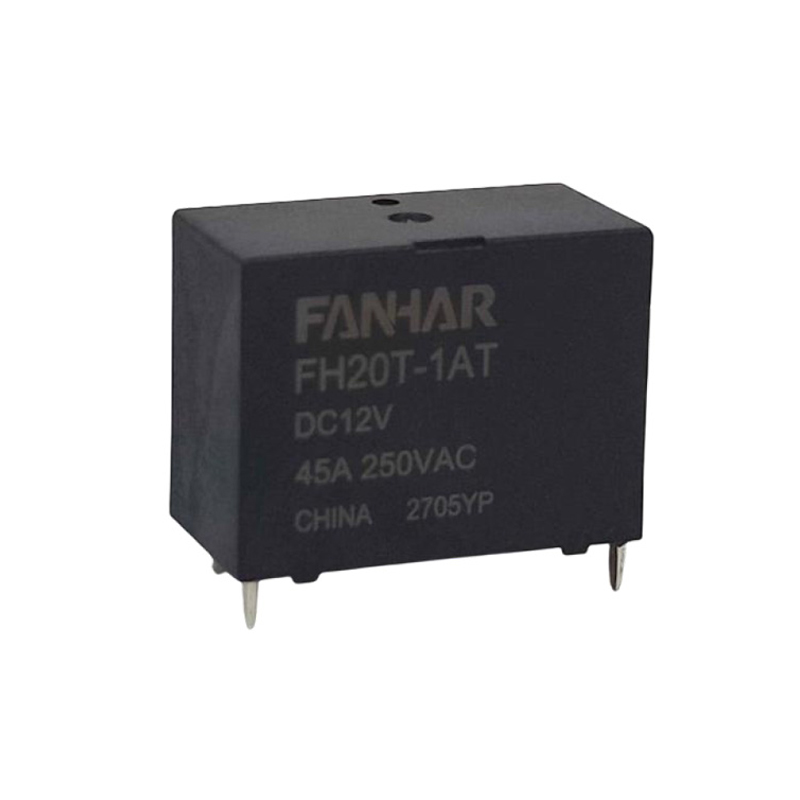
Power Relays are among the most widely used relay types in both industrial and commercial applications. As the name suggests, they are optimized for switching relatively high power levels — typically from a few amperes up to 30A or more — in response to a low-power control signal.
Key characteristics of power relays include:
- Contact ratings: Usually ranging from 10A to 30A at 250V AC or 30V DC
- Coil voltages: Available in 5V, 12V, and 24V DC versions for compatibility with common control systems
- Contact configurations: SPST, SPDT, DPDT depending on switching needs
- Mechanical life: Typically rated for 10 million operations or more under no-load conditions
Power relays are commonly found in home appliances (washing machines, air conditioners, refrigerators), energy meters, EV charging systems, and industrial machinery. Their ability to provide galvanic isolation while handling real-world electrical loads makes them indispensable components in these products.
Typical Applications of Power Relays
| Application | Typical Load | Relay Contact Rating |
| Air Conditioner Compressor | 1–3 kW | 15–30A / 250V AC |
| Smart Energy Meter | Up to 60A | 60A / 230V AC |
| EV Charger (Onboard) | 3–7 kW | 30–40A / 250V AC |
| Industrial Heating System | 2–10 kW | 20–40A / 250V AC |
| Washing Machine Motor | 400W–1 kW | 10–16A / 250V AC |
PCB Relay: Compact Control at the Board Level
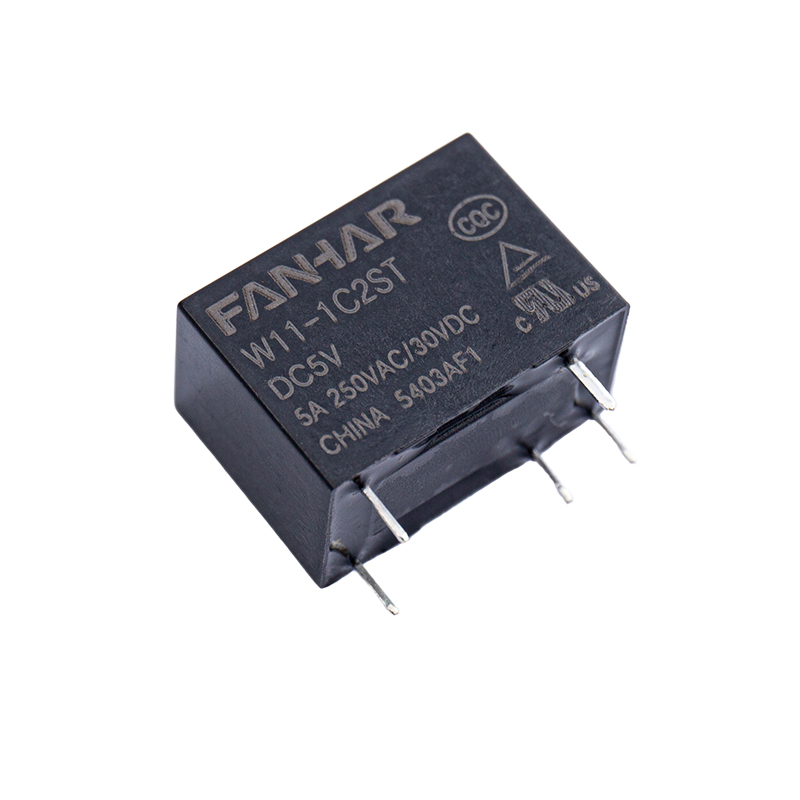
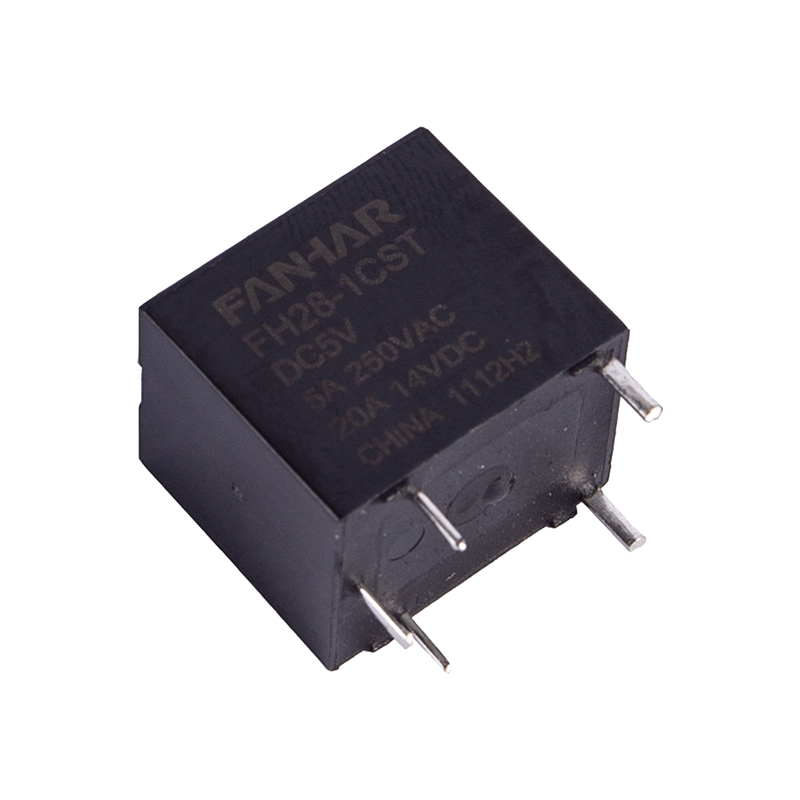
A PCB relay (Printed Circuit Board relay) is a relay designed to be soldered directly onto a circuit board. These compact devices combine the switching power of traditional relays with the space efficiency required for modern electronics. PCB relays are available in both through-hole (THT) and surface-mount (SMT) formats, making them adaptable to a wide range of manufacturing processes.
PCB relays are especially prevalent in:
- Smart home devices (smart plugs, thermostats, lighting controllers)
- Building automation systems
- Medical devices requiring isolated switching
- Telecommunications and data communication equipment
- Industrial sensors and instrumentation
Design Advantages of PCB Relays
The compact footprint of a PCB relay does not come at the expense of performance. Modern PCB relays are engineered to deliver:
- High sensitivity: Coil power consumption as low as 150 mW, enabling direct drive from microcontroller I/O pins
- Good contact ratings: Many PCB relays handle 5A to 16A at 250V AC despite their small size
- High dielectric strength: Rated at 4,000V or higher between coil and contacts, ensuring reliable isolation
- RoHS compliance: Lead-free construction for environmental responsibility
- Sealed versions available: Flux-proof and washable variants for wave soldering processes
The PCB relay's ability to integrate seamlessly into automated assembly lines while handling real electrical loads makes it a go-to component for product designers worldwide.
High-Current Relay: When Ordinary Switching Is Not Enough
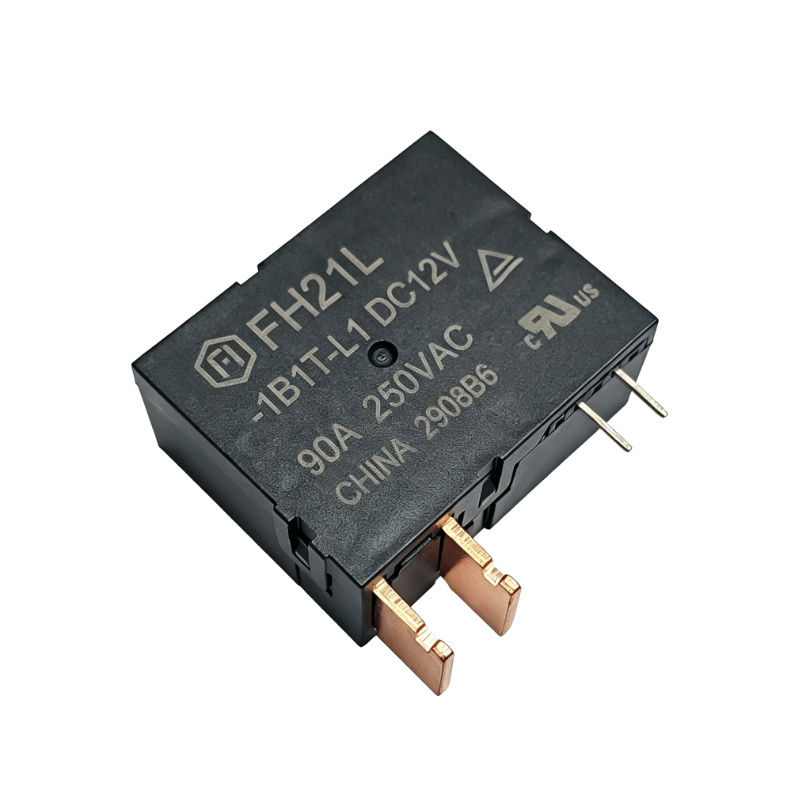
Not all electrical loads are created equal. Applications involving electric vehicle charging stations, solar inverters, motor control centers, and industrial power distribution demand relays capable of handling 40A, 60A, 100A, or even higher continuous current ratings. This is where high-current relays become essential.
A high-current relay is built with heavier-gauge contacts, more robust terminal designs, and enhanced heat dissipation features compared to standard relays. Key engineering considerations include:
Contact Material and Construction
High-current relay contacts are typically made from silver alloys such as AgSnO2 (silver tin oxide) or AgCdO, chosen for their resistance to arc erosion and welding at high currents. The contact area is also enlarged to reduce contact resistance and minimize heating during sustained current flow.
Arc Management
When switching large currents, an electrical arc forms between the opening contacts. High-current relays incorporate arc suppression chambers, magnetic blowout features, or gas-tight sealed designs to manage these arcs and extend contact life. Without proper arc management, contact erosion accelerates dramatically, reducing relay lifespan.
Thermal Considerations
A relay carrying 60A continuously generates significant heat. High-current relay designs account for this through:
- Low contact resistance (often below 5 milliohms)
- Adequate terminal cross-sections for heat dissipation
- Rating derating guidelines for elevated ambient temperatures
High-current relays are increasingly critical as renewable energy systems, EV infrastructure, and industrial automation continue to expand globally. In grid-tied solar systems, for instance, high-current relays handle the disconnection of photovoltaic arrays from the inverter during fault events or maintenance windows.
Phase Protection Relay: Safeguarding Three-Phase Equipment
Three-phase electrical systems power the vast majority of industrial motors, pumps, compressors, and other rotating machinery. However, three-phase power is inherently vulnerable to several types of faults that can quickly destroy expensive equipment if not detected promptly. The phase protection relay is specifically designed to monitor these conditions and disconnect the load before damage occurs.
What Conditions Does a Phase Protection Relay Monitor?
| Fault Condition | Description | Consequence if Undetected |
| Phase Loss | One of three phases disappears | Motor overheating, winding burn-out |
| Phase Reversal | Phase sequence is reversed | Motor runs backwards, mechanical damage |
| Phase Imbalance | Voltage unequal across three phases | Uneven current draw, vibration, overheating |
| Undervoltage | Phase voltage drops below threshold | Motor draws excessive current, overheating |
| Overvoltage | Phase voltage exceeds rated level | Insulation stress, premature motor failure |
How Phase Protection Relays Work
A phase protection relay continuously samples all three phase voltages. When a monitored parameter deviates beyond a preset threshold, the relay's output contact changes state — typically opening, which in turn de-energizes a contactor that disconnects the motor or load from supply.
Modern phase protection relays offer adjustable thresholds and trip delays, allowing engineers to tune sensitivity based on the application. For example, a pump in a water treatment plant may require a trip delay of 2–5 seconds to ride through momentary voltage dips without nuisance tripping, while a sensitive CNC spindle motor may require sub-second response.
Phase protection relays are standard requirements in industries such as:
- Water and wastewater treatment (pump protection)
- HVAC systems (compressor protection)
- Food and beverage processing
- Oil and gas facilities
- Mining and quarrying operations
Voltage Monitor Relay: Continuous Vigilance Over Your Power Supply
A voltage monitor relay (also called an under/over voltage relay) performs continuous surveillance of a circuit's supply voltage and triggers a switching action when the voltage moves outside a defined acceptable range. Unlike circuit breakers, which respond only to overcurrent, voltage monitor relays respond to both overvoltage and undervoltage conditions — making them complementary protection devices rather than replacements.
Single-Phase vs. Three-Phase Voltage Monitoring
Voltage monitor relays are available for both single-phase and three-phase power systems:
- Single-phase models monitor line-to-neutral or line-to-line voltage and are commonly used in residential systems, commercial HVAC, and sensitive laboratory or medical equipment.
- Three-phase models may combine voltage monitoring with phase sequence and phase loss detection, providing comprehensive protection in a single device.
Adjustable Parameters
Quality voltage monitor relays allow users to configure several key parameters:
- Overvoltage threshold: Typically adjustable from 105% to 130% of nominal voltage
- Undervoltage threshold: Typically adjustable from 70% to 95% of nominal voltage
- Trip delay: Ranges from instantaneous to several seconds, avoiding false trips from brief transients
- Auto-reset or manual reset: Determines whether the relay reconnects automatically once voltage returns to normal, or requires a manual reset
The auto-reset feature is particularly important for remote or unattended installations. A compressor in a remote pumping station, for example, benefits from automatic reconnection after a voltage dip rather than requiring a service call each time.
Voltage Monitor Relay vs. Surge Protector: What Is the Difference?
A common source of confusion is the distinction between a voltage monitor relay and a surge protector. The table below clarifies the key differences:
| Feature | Voltage Monitor Relay | Surge Protector |
| Response Speed | Milliseconds to seconds | Nanoseconds |
| Protection Type | Sustained overvoltage / undervoltage | Transient spikes (microseconds) |
| Switching Action | Disconnects load from supply | Clamps or diverts energy |
| Reusability | Fully reusable, long service life | May degrade with each event |
| Typical Use Case | Motors, compressors, appliances | Computers, TVs, electronics |
In many installations, both devices are used together — the surge protector handles transient spikes while the voltage monitor relay manages sustained abnormal voltage conditions.
Relay Types Compared: Choosing the Right Relay for Your Application
Selecting the correct relay type is one of the most consequential decisions in any electrical design. Using an undersized relay leads to premature failure; using an oversized one wastes cost and board space. The following overview helps narrow down the right choice:
Electromagnetic (Mechanical) Relays
These are the most traditional relay type, using a physical armature and metal contacts. Advantages include low on-state resistance, the ability to switch both AC and DC loads, and visual or audible confirmation of switching. Mechanical relays are the dominant choice for power switching applications in appliances, meters, and industrial equipment.
Solid State Relays (SSR)
SSRs use semiconductor devices (thyristors, triacs, or transistors) instead of mechanical contacts to switch the load. They offer silent operation, zero mechanical wear, and high-speed switching. However, they have higher on-state voltage drop, generate more heat under load, and typically cost more than equivalent mechanical relays. SSRs are preferred for applications requiring frequent switching cycles exceeding 1,000 operations per day or where vibration makes mechanical relays impractical.
Reed Relays
Reed relays use a hermetically sealed glass envelope containing two ferromagnetic contact blades. They are extremely fast (operate in under 1 ms), have very low contact resistance, and offer excellent isolation at high frequencies. Reed relays are ideal for test-and-measurement equipment and telecommunications applications but are limited to low-current applications (typically below 1A).
Latching Relays
Latching relays maintain their switched state even after the control signal is removed. A brief pulse sets or resets the relay, and it stays in that state indefinitely without consuming holding power. This makes them ideal for battery-powered applications and energy meters where zero standby power consumption is critical.
Quick Comparison Table
| Relay Type | Max Current | Switching Speed | Best For |
| Electromagnetic | Up to 100A+ | 5–15 ms | General power switching |
| Solid State | Up to 100A | Less than 1 ms | High-frequency switching |
| Reed | Less than 1A | Less than 1 ms | Signal, test equipment |
| Latching | Up to 60A+ | 10–20 ms | Energy meters, battery devices |
| Phase Protection | Output contact rated | Adjustable delay | 3-phase motor protection |
Key Parameters to Evaluate When Selecting a Relay
Whether you are specifying a relay for a new product design or replacing a failed unit in the field, these are the most important parameters to evaluate:
Contact Rating
The contact rating defines the maximum load the relay contacts can switch. It is expressed as both a current value and a voltage value (e.g., 10A / 250V AC). Always ensure the rated values exceed your actual application requirements by a comfortable margin — a 30% derating factor is common engineering practice to ensure reliability over the product's lifespan.
Coil Voltage and Sensitivity
The coil voltage must match the control signal available in your system. Common options include 5V DC, 12V DC, 24V DC, 48V DC, and 24V AC. Coil sensitivity (expressed in milliwatts) determines whether the relay can be driven directly from a microcontroller or requires a driver transistor. Most modern PCB relays have coil power consumption below 200 mW.
Electrical Life
Electrical life is specified as the number of switching operations at rated load. This is always significantly lower than mechanical life. A relay rated for 100,000 electrical operations at full load may have a mechanical life of 10 million operations under no-load conditions. For high-cycle applications, verify that the electrical life meets the expected service interval.
Dielectric Strength
Dielectric strength specifies the voltage the relay can withstand between its coil and contacts without breakdown. For safety-critical applications, relays with reinforced insulation rated at 4,000V or higher are required. This is particularly important in equipment connected to mains power where protection of the control circuit from mains voltage transients is essential.
Operating Temperature Range
Relay performance can degrade at temperature extremes. Verify that the specified operating temperature range covers the full range of environmental conditions the relay will experience, including worst-case ambient temperature plus self-heating under load.
Certifications and Compliance
Depending on the target market and application, relays may need to carry one or more of the following certifications:
- UL/cUL: Required for products sold in North American markets
- TUV/VDE: European safety certification
- CQC: Required for China market
- RoHS: Lead-free construction for environmental compliance
- REACH: European chemical substances regulation
Relay Applications Across Industries
Relays are truly universal components, appearing in virtually every industry that uses electricity. Here is a closer look at how different relay types serve specific industry needs:
Smart Home and Building Automation
PCB relays and power relays are the backbone of smart home devices — from smart switches and plugs to intelligent lighting controllers and automated blinds. These applications demand relays with compact footprints, low coil power consumption, and compatibility with 3.3V and 5V microcontroller outputs. Latching relays are also popular here for their zero standby power advantage.
Renewable Energy Systems
Solar inverters, wind turbine controllers, and battery energy storage systems rely on high-current relays for safe grid connection and disconnection. In these applications, the relay must handle not only high continuous current but also the challenging switching conditions associated with DC loads — where arc suppression is more difficult than in AC applications. Relays used in these systems typically require DC load ratings explicitly listed by the manufacturer, since AC and DC contact ra
 Previous