 EN
 English
 Español
 русский
 简体中文


News
Home / News / Industry News / Core Application Areas and In-Depth Analysis of Relays: From Working Principle to Key Scenarios
Content
As a fundamental component of electrical control, the core value of a relay lies in "isolation and amplification"—that is, using a small signal to control a high-power circuit while achieving electrical isolation between the control side and the load side. This capability is precisely why, a century later, relays remain an indispensable cornerstone of countless modern technical systems. This article provides a systematic and in-depth review of relay working principles, core application areas, and frequently asked questions.
To understand the wide application of relays, one must first understand the physical process of how they work. When a small current flows through the relay coil (electromagnet), a magnetic field is generated, attracting a movable metal plate (armature). The movement of the armature pushes one or more sets of electrical contacts to close or open, thereby controlling a high-current circuit.
The key advantage of this process is complete electrical isolation: there is no direct electrical connection between the control signal circuit (coil side) and the controlled load circuit (contact side). This means that a microcontroller signal of only 5 volts and 20 milliamps can safely and reliably control a 220-volt, 16-ampere air conditioning compressor. In addition, the contact materials (such as silver alloys, silver cadmium oxide, etc.) and structural design of relays enable them to withstand the inrush current at the moment of closing and quickly extinguish the arc upon opening, which directly determines their service life and reliability under specific loads (such as motors and lamps).
| Stage | Key Element | Function |
|---|---|---|
| Electricity→Magnetism | Coil energized generates magnetic field | Converts electrical signal into magnetic force |
| Magnetism→Mechanical | Armature attracted and moves | Pushes contacts to actuate |
| Mechanical→Circuit | Contacts close/open | Achieves load circuit on/off |
| Isolation | No electrical connection between coil and contacts | Protects control side, ensures safety isolation |
This is one of the most core application areas of relays, where their role is crucial.
The "Commander" of Complex Processes: In factory automation production lines, relays receive low-voltage commands from programmable logic controllers (PLCs) and then, like a commander, start or stop high-power execution equipment such as motors, hydraulic pumps, and heaters. They ensure the precise rhythm and logical sequence of production processes. In some process control applications, relays are also used to implement simple logic interlocking—for example, ensuring that the heater must never be energized before the cooling system starts, thereby preventing equipment damage.
The "Upgraded Fuse" of Power Systems: Protection relays are extremely critical equipment in power systems. They are not simple fuses but intelligent guardians. For example, overcurrent relays continuously monitor line current; upon detecting a short circuit or overload, they instantly (within milliseconds) trigger the circuit breaker to trip, precisely isolating the fault point and preventing transformer burnout or large-scale power outages. Differential protection relays, by comparing currents at both ends of a line, can detect even minute internal faults with extreme sensitivity. This ensures the stability and safety of the entire power grid.
The "Reliable Executor" in Harsh Environments: In harsh environments such as railway systems (e.g., track signal switching, traction power supply control) characterized by high voltage, strong vibration, and heavy dust, electromagnetic relays are often more reliable than precision semiconductor devices due to their robust physical structure and the fact that they require no heat sinks. They can reliably break high currents, ensuring accurate train operation signals. For example, in switch point control circuits, relays must ensure sufficient contact pressure even under ice and snow coverage and severe vibration, ensuring that switch points close tightly in place—otherwise, it could lead to traffic accidents.
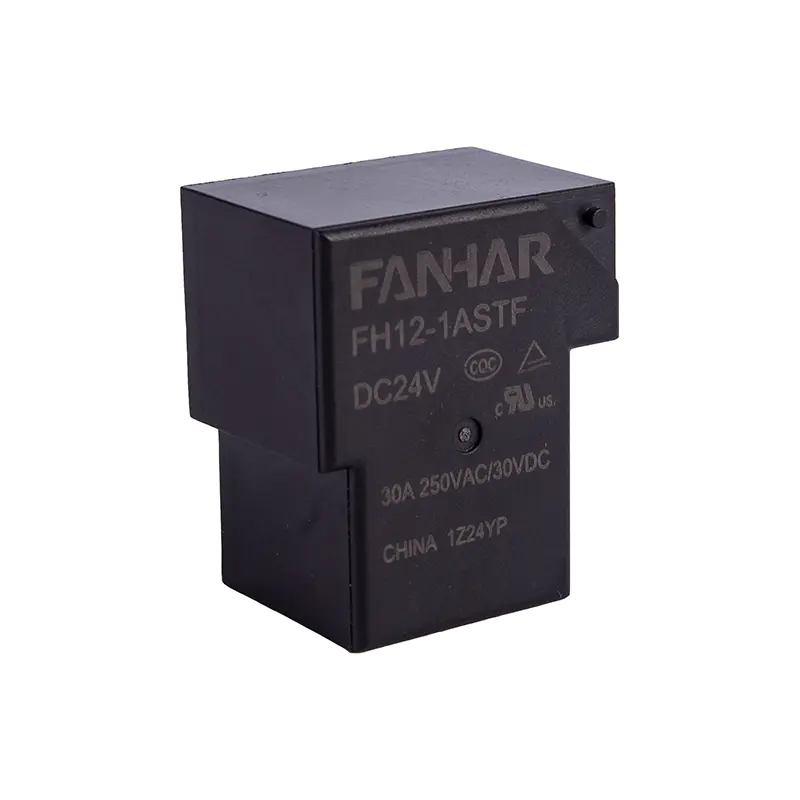 FH12 30A 40A Power Relay for Industrial Control40A switching, 2.5kV coil-contact isolation, UL/TUV/CQC certified—ideal for industrial control, spot welding, and power supplies.View Product →
| Scenario | Relay Role | Key Requirements |
|---|---|---|
| Automated production lines | Receive PLC commands to drive execution equipment | Logic interlocking, precise rhythm |
| Power system protection | Overcurrent/differential protection, trigger tripping | Millisecond response, selective isolation |
| Railway systems | Track signal switching, traction power supply control | Vibration resistance, dust resistance, high-current breaking |
Modern automobiles contain numerous relays, ranging from a dozen to over a hundred, responsible for managing the vehicle's "power-hungry consumers."
Logic Isolation and Power Driving: The vehicle's body control module (BCM) or ECU typically operates at low-voltage logic levels of 5V or 3.3V and cannot directly drive headlights (55W-65W), fuel pumps (high current), or starter motors (hundreds of amperes). Relays serve as a critical "intermediary" here: receiving weak signals from the ECU and connecting the battery to the high-current load circuit. The starter relay is the most typical example—it uses a small current to control a huge contact, delivering hundreds of amperes of current to the starter motor.
Functional Integration and Wiring Simplification: Through a single signal (e.g., pressing the rear window defog button), a relay can be controlled, and this relay can simultaneously connect the rear window heating element, both side mirror heaters, and even illuminate a dashboard indicator light. This simplifies complex automotive wiring harnesses, reduces costs and failure rates, and improves system reliability. Meanwhile, automotive relays are typically designed as sealed types to withstand gasoline vapor, salt spray, and high temperatures in the engine compartment.
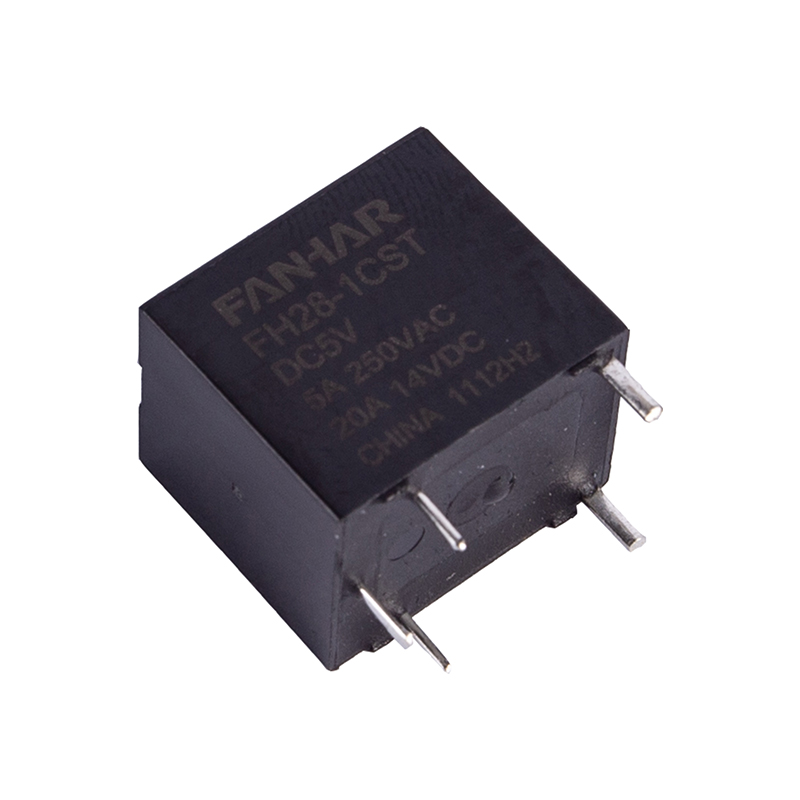
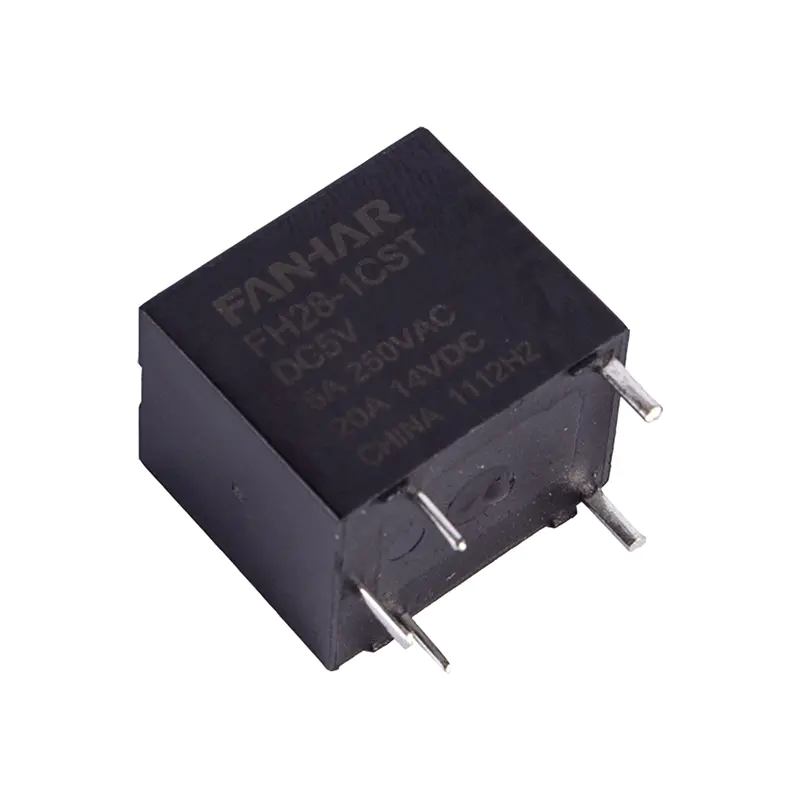 FH28 5A 20A Automotive RelayThe FH28 is a compact 20A 14VDC automotive relay with 1A/1C contacts, UL Class F insulation, and RoHS compliance, ideal for door locks, windows, and turn lights.View Product →
Although modern communications extensively use optical switches and electronic switches, relays still play a unique role in many base stations, antenna test equipment, and dedicated communication networks.
Physical Switching of Signal Paths: In certain high-frequency (e.g., RF) or signal switching applications requiring extremely high isolation (for example, switching between different antennas or selecting different frequency band signal channels in test equipment), mechanical relays can provide lower insertion loss and higher off-isolation (up to tens of decibels) than electronic switches. This means that in the "off" state, almost no signal leaks through, ensuring that signals are not distorted or cross-coupled during transmission—crucial for guaranteeing high-precision measurement and clarity of critical communications.
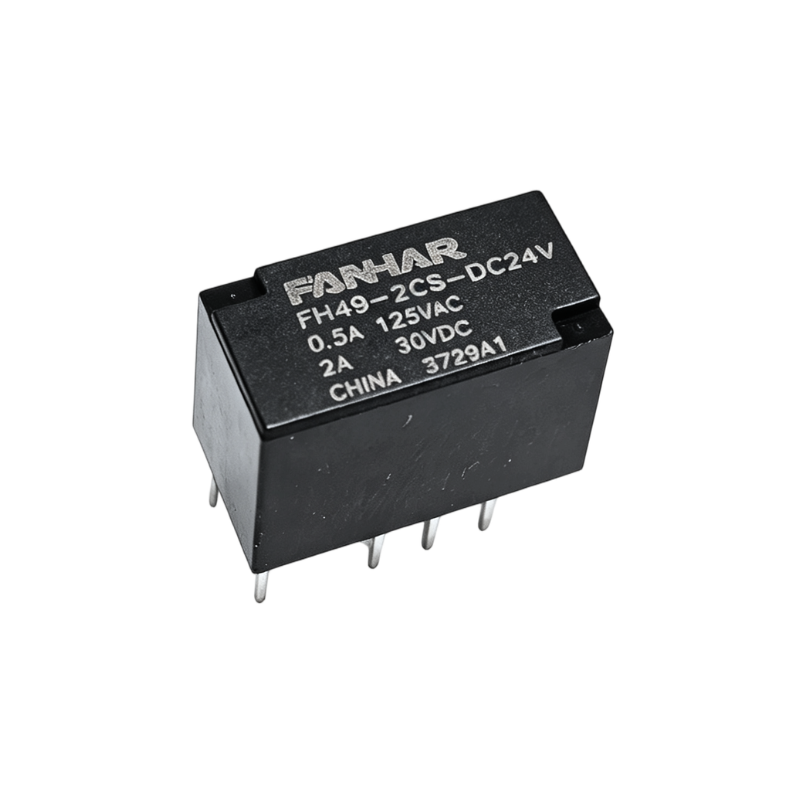 FH49 0.5A 2A 3A Signal RelayThe FH49 is a compact third-generation signal relay with bifurcated contacts, 2.5kV surge resistance, and EN60950/EN41003 compliance, ideal for power protection, automation, and communication.View Product →
With the spread of smart homes, relays are transitioning from industrial components into households, becoming a bridge connecting digital commands with the physical world.
Intelligent Retrofitting of Traditional Devices: The core of many smart home modules (such as smart switches, smart sockets, and smart circuit breakers) is a small relay. It receives weak electrical signals from mobile apps, voice assistants, or sensors, and then through the pull-in and release of mechanical contacts, emits a clear "click" sound to control the power on/off of devices such as lights, curtain motors, and smart door locks. This sound is the relay at work.
Energy Efficiency Management and Safety Assurance: In HVAC systems, relays can precisely control the start/stop of air conditioning compressors, boilers, or fresh air fans based on temperature sensor signals. When a room is unoccupied, the system can automatically cut off unnecessary appliance power through relays, achieving deep energy savings and eliminating standby power consumption. They are also used in security systems—for example, when a smoke detector is triggered, the relay can automatically shut off the gas solenoid valve or activate a powerful exhaust fan.
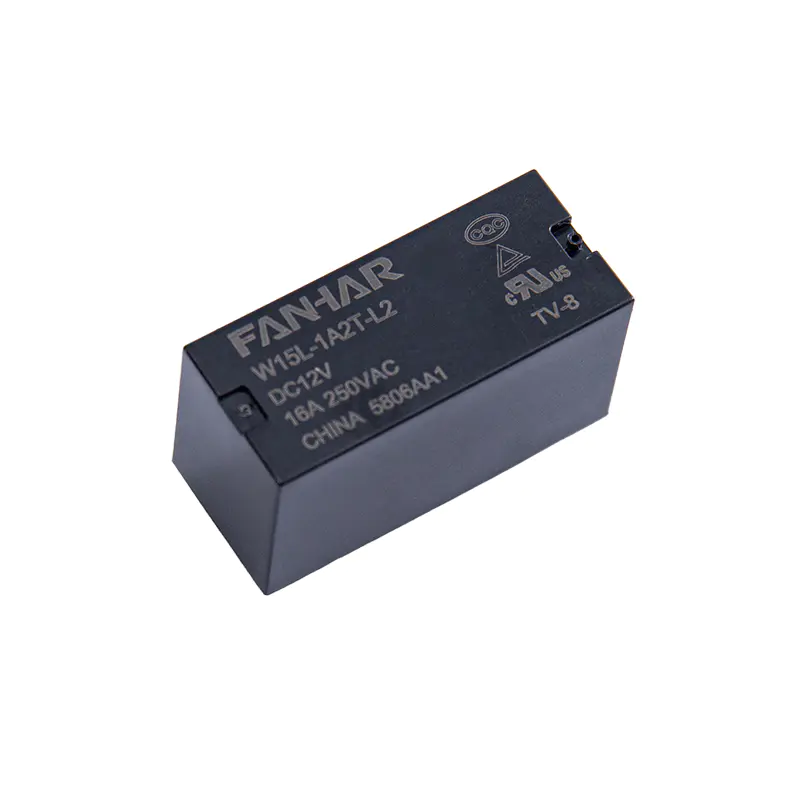 W15L 16A 20A Latching Relay for Smart Home20A switching, 750A/10ms short-circuit withstand, hand-control switch, 105°C rated, UL/TUV/CQC certified—ideal for smart home and lighting control.View Product →
This is the application with the highest reliability requirements, where no error is tolerable, and specific safety standards are often required.
The Core of Fail-Safe Mechanisms: In emergency shutdown systems (ESD) or safety circuits, relays are often designed with "normally open" or "normally closed" logic. For example, a safety door switch is connected in series with the coil of a safety relay. When the door is unexpectedly opened, the coil is de-energized, and its contacts immediately open using the internal spring force, directly cutting off the robot's power supply. This physical disconnection method is one of the highest levels of safety assurance—far beyond what software commands can provide—because it does not depend on whether the program is running correctly.
Fault Tolerance and Redundancy Design: In some critical process control applications (such as chemical plants and nuclear power plants), forcibly guided relays (also called mechanically linked relays) are used. All contacts (normally open and normally closed) of such relays are forcibly linked through a mechanical structure, ensuring that when one set of contacts is welded together due to overload, the other set absolutely cannot close. By monitoring the status of the latter, the control system can reliably detect contact failure, thereby forming a high-integrity safety circuit and preventing catastrophic accidents where power cannot be cut off in emergency situations.
| Mechanism | Principle | Value |
|---|---|---|
| Fail-safe (normally closed logic) | Coil de-energized→spring force opens contacts | Physical power cutoff independent of software |
| Forcibly guided relay | Normally open/normally closed contacts mechanically linked | Detects contact welding, forms high-integrity circuit |
In the new energy field, relays undertake critical functions such as high-voltage/high-current switching, pre-charge control, insulation isolation, and safety protection. Fanhar has launched multiple dedicated relay products for scenarios including photovoltaic inverters, energy storage systems, and charging facilities.
| Series | Contact Switching Capacity | Carrying Capacity/Rated Load | Withstand Voltage/Insulation | Contact Material/Structure | Typical Applications |
|---|---|---|---|---|---|
| FH66NE-100 | 40A | 100A carrying capacity | Coil-contact 5000V, surge 10kV, Class F insulation | — | Solar inverters, pre-charge circuits, industrial control |
| FH67NE | 200A/270A | Max switching 275A, breaking capacity 275,000VA | Meets 1000VAC | AgSnO₂, double-break, gap ≥4.0mm | PV inverters, energy storage systems, industrial control |
| FH22L 100A | 100A | — | 4kV dielectric withstand, complies with IEC62052-31 UC2 | Magnetic latching structure | Charging piles, PV inverters, energy storage systems |
| W12T-50 | Max 60A 277/250VAC | — | Standard 2500VAC, high-voltage type 4000VAC | AgSnO₂, mechanical life 5×10⁶ cycles | Electric vehicles, charging piles, PV inverter main circuits |
A: Both operate on similar principles, using a coil to control contact opening and closing. The main differences lie in application scenarios and capacity: relays are typically used to control low-power loads and signal circuits with relatively small contact capacity; contactors are mainly used to control high-power loads (such as motor main circuits), featuring large capacity, strong arc extinguishing capability, and are often equipped with auxiliary contacts for logic control.
A: There is no direct electrical connection between the control side (coil) and the load side (contacts) of a relay; energy is transferred through a magnetic field. Therefore, low-voltage control signals can safely control high-voltage load circuits, preventing high-voltage side faults from propagating to the control side and protecting personnel and equipment safety.
A: Normally open (NO) contacts are in the open state when the coil is not energized and close when energized; normally closed (NC) contacts are in the closed state when the coil is not energized and open when energized. Both are commonly used to implement different safety logic—for example, safety circuits often use normally closed contacts to achieve a "de-energize-to-open" fail-safe mechanism.
A: At the moment contacts open, the energy stored in inductive loads in the circuit produces an arc across the contact gap. Relays are designed with contact materials (such as silver alloys), contact spacing, and arc extinguishing structures to withstand inrush current and quickly extinguish the arc. In actual selection, relays with appropriate capacity and arc extinguishing capability should be chosen based on load type (motors, lamps, etc.).
A: Protection relays are dedicated devices used in power systems to monitor line status, detect faults such as short circuits or overloads, and trigger circuit breaker tripping, emphasizing millisecond-level response and selective isolation; ordinary relays are mainly used for general signal transmission and load on/off control. The two differ significantly in functional positioning, precision requirements, and reliability standards.
If you have any questions, please fill out the contact form at the bottom of the page and contact us.

 Previous